








The Three Elements of the Waldorf Playroom: Why Open-Ended Wooden Toys, Play Silks and Waldorf Dolls Work So Beautifully Together


More Than Just Toys
Over the past few months, it has been wonderful to see open-ended play receive the attention it deserves. More and more families are discovering the joy of simple toys, natural materials and childhood led by imagination rather than instructions.
Alongside this growing interest, certain toys have quite rightly become icons of open-ended play. Wooden blocks are stacked into towering castles, rainbows become bridges and tunnels, and loose parts are transformed into endless creations. These beautiful materials have inspired countless families to embrace a slower, more imaginative way of playing.
Yet, as I watch these conversations unfold, I sometimes find myself wondering if one important piece of the picture has quietly slipped into the background.
The Waldorf doll.
Not because every child should play with dolls in the same way, or because every playroom needs to look the same, but because a simple doll brings something entirely different to imaginative play.
After many years of raising my three children, working as an educator, and helping families discover the joy of open-ended play, I have found myself returning to the same three elements time and time again.
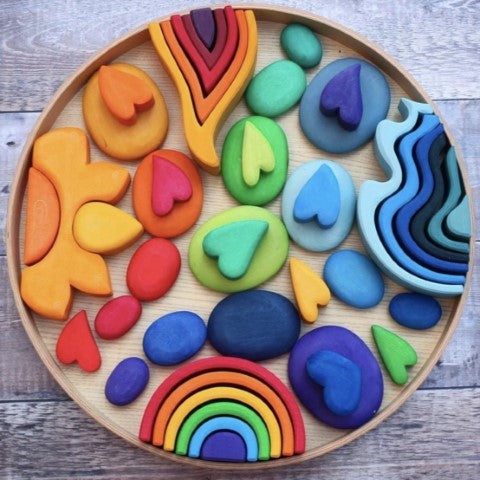
Open ended wooden toys.
Play silks and cloths.
A Waldorf doll.
Individually, each has its own place in a child's play. Together, however, they create something wonderfully balanced. Wooden toys provide the world, play silks allow it to change and evolve, while the Waldorf doll quietly invites care, relationship and storytelling into everything else.
These three elements don't compete for a child's attention. They inspire one another, allowing play to unfold naturally, growing richer as each new idea builds upon the last.
And when they are given one final, precious ingredient...time...something rather magical begins to happen.
More Than the Sum of Their Parts
When we talk about open-ended play, it is often easy to think of each toy in isolation. We admire the endless possibilities of a beautiful set of wooden blocks, delight in the way a simple play silk can become almost anything a child imagines, or appreciate the quiet beauty of a Waldorf doll. Yet children rarely see these things as separate. They instinctively gather together whatever their imagination needs, weaving different materials into a single, unfolding story where each element inspires the next. It is this beautiful relationship between them that has always fascinated me, and perhaps explains why I return to these three elements time and time again.
A Grimm's rainbow that began the morning as a little rocking bed for a much-loved doll may later become a bridge leading across a rushing river, before finally finding a new purpose, combined with a semi-circle to create a little table around which friends gather to share an imaginary feast. The blue play silk that once wrapped a sleepy doll becomes the water beneath the bridge, then a picnic blanket as beloved toys gather together to enjoy afternoon tea. Wooden bowls become breakfast dishes, tiny boats sailing across a play silk ocean or, turned upside down, stepping stones leading through a fairy garden. Loose parts are gathered like treasures from nature, becoming seashells collected on the beach, autumn leaves scattered beneath tiny feet, mushrooms growing deep in the forest, raindrops sparkling on the ground or little acorns waiting to be discovered. Nothing about the toys has changed. Only the child's imagination. Yet with every new idea, each element quietly inspires the next, and the possibilities continue to grow.
Perhaps this is the quiet magic that lies at the heart of open-ended play. These materials are not remarkable because of what they do individually, but because of the way they continually invite one another into play. One idea flows so naturally into the next that it becomes almost impossible to remember where the story first began. The toys themselves quietly fade into the background, leaving only the child's imagination to lead the way.

The World They Build
One of the first things I notice when children become deeply absorbed in imaginative play is that they begin creating places. Before there are stories to tell or adventures to embark upon, they instinctively gather together whatever they need to build a world of their own. A little house appears beneath a chair, a bridge stretches across an imaginary river, a stable is built for a favourite horse and a cosy bed is prepared for a sleepy doll. It doesn't matter whether these worlds are simple or elaborate. What matters is that they belong entirely to the child who created them.
This is one of the reasons I find myself returning to open-ended wooden toys time and time again. Not because they are made from wood, but because the very best of them leave the world entirely in the child's hands. A rainbow is never just a rainbow. A handful of blocks is never just a tower. They become whatever the story needs them to become, changing and evolving as the child's ideas evolve alongside them.
As children grow, these worlds grow alongside them, the world changes constantly because the child's imagination is constantly changing with it.. Yet no matter how beautiful the little world becomes, it is rarely built simply for the sake of building...

The Heart of the Story
It is often said that children love to build, and anyone who has watched a child immersed in open-ended play will know this to be true. Yet I have noticed that, sooner or later, something begins to change. The little house is no longer simply a house. The carefully built bridge is no longer just something to cross the water. The tiny table, lovingly arranged with bowls and wooden treasures, is no longer complete on its own.
It is waiting for someone.
Someone to wake up in the little bed. Someone to cross the bridge. Someone to be wrapped in a warm blanket after a long walk through the forest. Someone to gather flowers, celebrate a birthday, bake bread, comfort a friend or simply sit quietly and watch the rain fall outside.... A world becomes meaningful when someone belongs within it.
It is this gentle shift that has always intrigued me. The play begins to move beyond creating places and into creating relationships. The child is no longer simply building a world; they are beginning to care for the life within it. Whether that someone is a Waldorf doll, a favourite teddy, a much-loved animal or an entire family of woodland creatures matters very little. What matters is the relationship that begins to grow between the child and the world they have created.
For me, this is where the Waldorf doll finds its place,, it quietly steps into the world the child has already created, inviting everyday moments that are so often overlooked in children's play. The Waldorf doll doesn't replace the world the child has already created. Instead, it gives that world a heartbeat. A doll needs somewhere to sleep, someone to cook for it, somewhere safe to rest when it is poorly and a favourite blanket to keep it warm. Suddenly, the rainbow becomes a bed, the play silk becomes a quilt and the bowls hold pretend soup. The world that began with building is now filled with love, kindness and care.

The Ever-Changing Landscape
If open-ended wooden toys provide the foundations of a child's world, and a Waldorf doll brings warmth and relationship into that world, then play silks are perhaps the element that allows everything to remain beautifully fluid. They remind us that a child's imagination is never still. A story rarely follows a straight path, and neither should the materials that support it.
Unlike almost any other play material, a simple square of cloth asks for nothing at all. It has no fixed shape, no obvious purpose and no expectation of what it should become. Instead, it quietly responds to whatever the child needs in that moment. One morning it may become a flowing river winding between wooden bridges, only to become a cosy blanket wrapped around a sleepy doll a few moments later. By the afternoon it has become a picnic blanket, a sail to carry a boat across the sea or a leafy forest floor waiting to be explored by woodland animals. Nothing about the silk has changed, yet the world around it has been transformed again and again.
Perhaps this is why play silks and cloths feel so completely at home alongside open-ended wooden toys and Waldorf dolls. They have an extraordinary ability to connect one idea to the next, allowing the story to evolve without ever needing to begin again. The bridge now stretches across water instead of grass. Autumn quietly gives way to winter beneath a blanket of white silk. A doll wrapped in a sling is soon tucked beneath the same cloth for an afternoon nap, before it becomes the roof of a little den. The child is never limited by what the cloth is. Instead, they are free to imagine what it could become.
There is something wonderfully gentle about that kind of play. It asks children to notice rather than rush, to imagine rather than consume, and to remain open to the idea that today's story does not need to look like yesterday's. The world they have created is free to change as often as their imagination changes, and perhaps that is one of the quiet reasons play silks have remained such a treasured part of Waldorf-inspired playrooms for generations.

The longer I watch children play, the more convinced I become that the richest play is often the simplest. It doesn't begin with elaborate toys or carefully planned activities, but with a few beautiful, open-ended materials, the freedom to use them in ways no adult could ever predict, and long, uninterrupted stretches of time in which imagination is allowed to wander.
Open-ended wooden toys, play silks and a Waldorf doll have become the three elements I return to again and again, not because they create imaginative play, but because they quietly support what children already do so naturally. They build worlds. They fill those worlds with love, adventure and belonging. They change and reshape them as their ideas grow and evolve.
Perhaps that is the real beauty of the Waldorf playroom. It isn't defined by the toys that sit upon the shelves, but by the childhood that unfolds around them. A childhood where stories are never finished, imaginations are never hurried and every new day begins with the simple question...
"What shall this become today?"
With warmth and wonder,
Mama Oak🍃
About the Author
Melody is the founder of Little Acorns to Mighty Oaks, a UK store specialising in Waldorf-inspired sustainable toys that encourage imaginative and open-ended play. With 13 years’ experience in early childhood education and as a mother who home educates her three children, Melody shares practical tips and insights about Waldorf toys, open-ended play, sustainable toys, child-led learning, and sustainable living. Read more about the founder here.

Leave a comment